



I fully understood that when I made this Sub-8 attempt a “public spectacle” with teasers and self-hype, I’d probably get a lot of haters and doubters along the way.
Especially when I posted my first blog to the Slowtwitch forum, which, funny enough, has now been flagged as spam and taken down.
The core demographic of Slowtwitch is white old men in their 60’s who yell at clouds and kids to get off their lawn.
Anyways, back to the elephant. Let’s eat.
Historical Reference
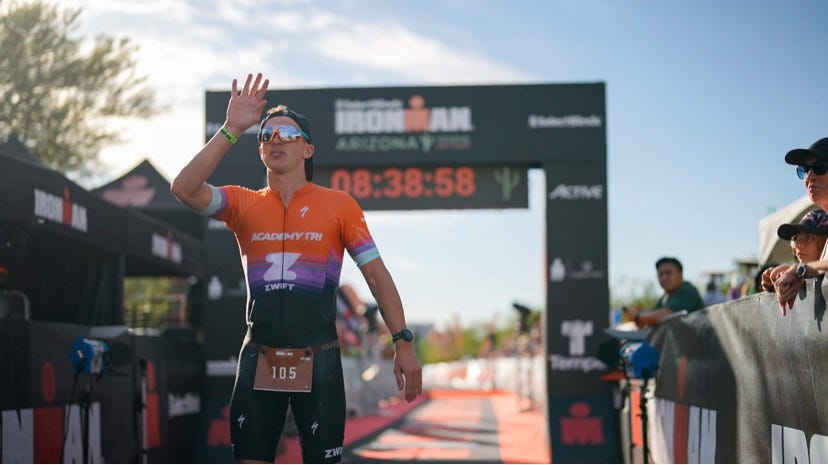
My best IRONMAN to date came at IRONMAN Arizona 2021, where I went 8:38: 56 swim, 4:35 bike, and 3:00 run.
So where do I plan to make up that 38 minutes plus? Am I even fit enough 5 years later after taking 18 months off?
My most recent IRONMANs haven’t been too pretty either - a 9:41 at IRONMAN Texas in 2024 (where I walked the second half of the run) and 9:18 at the 2024 IRONMAN World Championships in Kona. The race that “retired” me.
Now, eyes forward to California.
The fastest times from IRONMAN California over the last 3 years (was never a professional field):
2025:
2024:
2023:
So over the last 3 years, only 1 athlete (arguably one of the best amateur triathletes ever and current AG Kona course record holder) has gone sub-8 on this course.
Looking at the times, 2023 definitely had the best river current, but also had some rain throughout the day.
So the stage is set.
My best time: 8:38.
Course best time 7:56.
How do I make up the 38+ minutes to go Sub-8 and prove these Slowtwitch haters wrong, while proving myself right?
The Swim
There’s no hiding why I picked California for my Sub-8 attempt. The downstream swim makes the attempt a little more feasible.
IRONMAN describes the course as: “a downriver swim with athletes starting in the American River near Township 9 Park. The 2.4 mile swim course is a point to point into the Sacramento River and exiting near the famous Tower Bridge.”
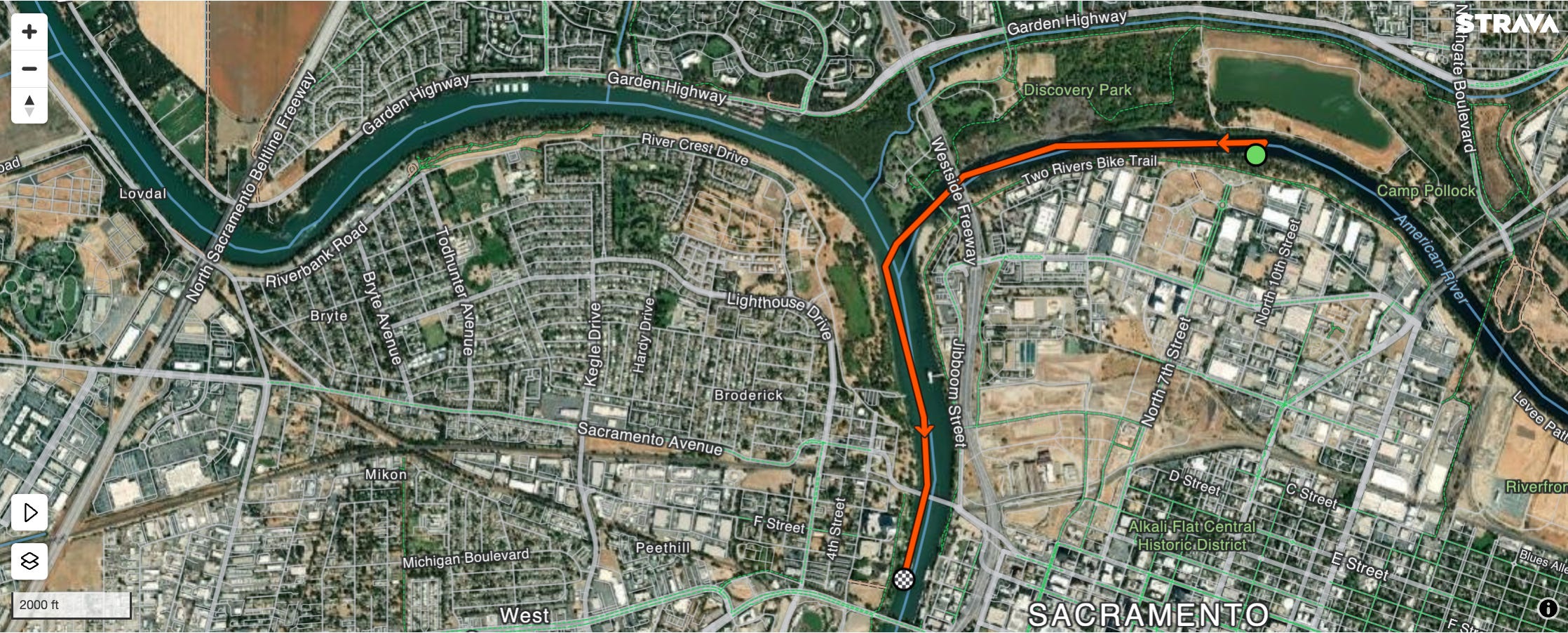
The key with the swim is how strong the current will be. The race starts with 2000m in the American River, where last year it seemed the current was non-existent, and then joins the Sacramento River, where the current kicks up.
The current is often dictated by the water levels in reservoirs and the flow is dictated by operators.
Who do I have to pay to get a heavy flow on race day?
My goal for the swim to go sub-40 minutes (obviously current dictated). In Dan Plews’ 7:56 course record, he swam 36 minutes. My 40 min swim, knocks 16 minutes off my Arizona swim time. Leaving a gap of 22 minutes to make up on the bike and run.
The Transitions
Never forget about transitions. At California we have to navigate out of the river and run up to the transition area, so T1 is usually a bit longer than most races. Average times among the top finishers are in the 5-7 minute range.
Let’s go with 5 min for me, since I’m usually pretty quick.
Skipping ahead to T2, this one is pretty quick. Drop the bike, grab the shoes and go. Average times are usually 3-4 minutes here.
Let’s take the lower number and plan on 3 minutes.
That’s a total of 8 minutes just in transition.
So now I have a ~40 min swim + 8 minutes of transitions. Can we bike and run under 7:12?
The Bike
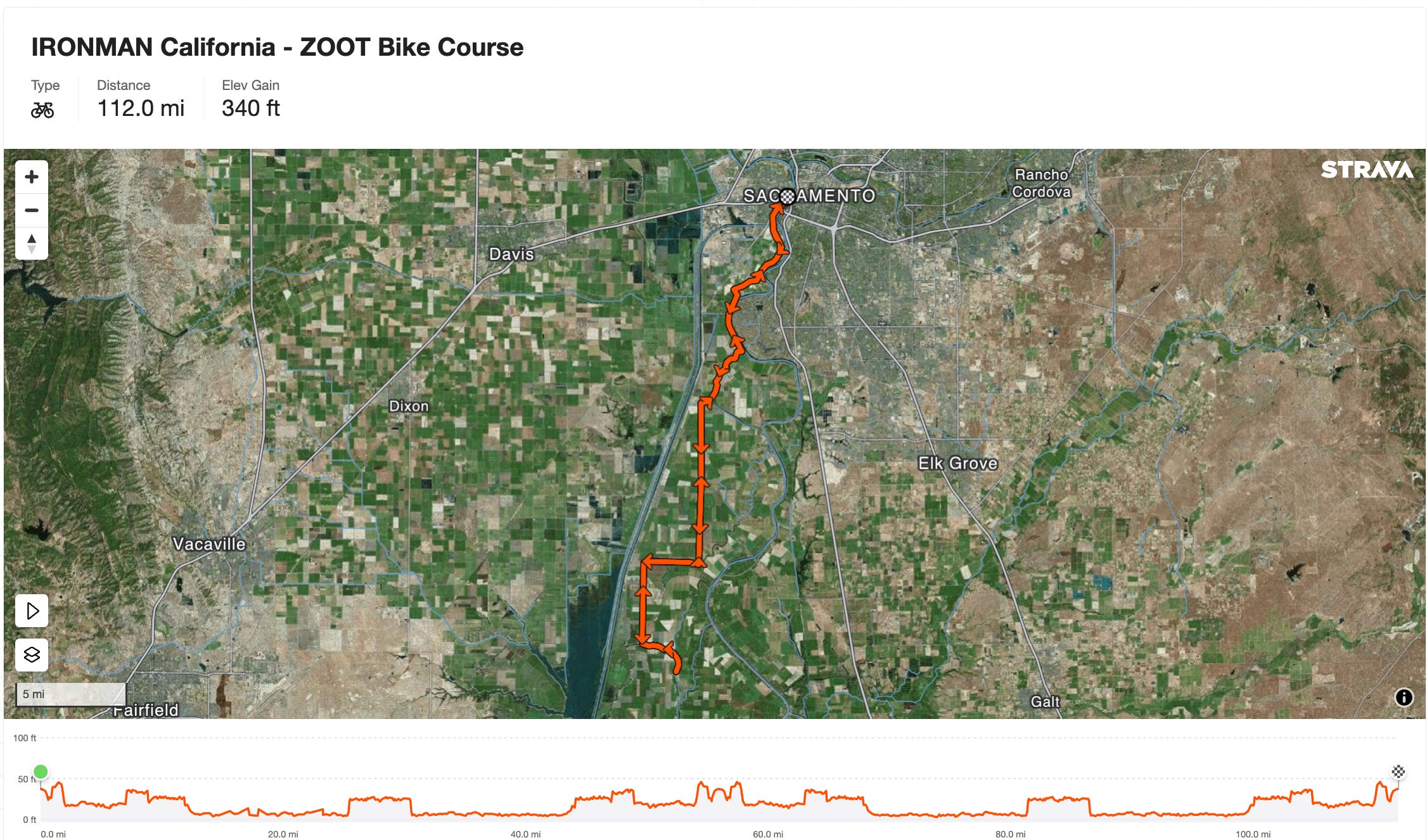
The California bike as described by IRONMAN: “a flat and fast, two-loop tour of the beautiful farm and wine country. Athletes will be able to test their fitness and break their best on this flat bike course.”
Testing my fitness and breaking my best will definitely be needed on the day.
My fastest IRONMAN bike split has hovered around 4:35 (IRONMAN Texas, IRONMAN Arizona, and IRONMAN World Champs 2022).
My recent 70.3 bike times this year are 2:09 and 2:06 from Rockford and Muncie. You might think, how are you going to ride double the distance at basically the same speed?
The California course offers the flattest course I’ve even completed. The Strava map on the site puts the course at 340ft of total elevation gain. I’ve seen athlete’s actual files that range above this, but let’s just go with what they have.
My goal for the bike is to bike as close or under 4:20 as possible.
Over the last 3 years, the top bike splits include:
4:16 - Mihai Vigariu (2025)
4:19 - Jacob Downey (2025)
4:21 - Arto Sorvoja (2024)
4:22 - Lee Mount (2023)
4:23 - Dan Plews (2023)
So, in order to lay down a sub 4:20 bike, I’ll have to crack into the top 5 overall performances on that course.
Wind is always a factor, but you can’t control that (or worry about it till race day).
With my power goals and projections from Best Bike Split (future blog), I’m projecting to ride in the 4:18-4:22 range for the 112 miles.
That puts us at :40 min swim, 8 min transitions, and a 4:20 bike for 5:08 total.
Now we have to do the marathon in 2:52 or less.
The Run
Let’s be a little more practical here and say there’s a slower current or a bit of wind on the bike - put our overall time a 5:10 for the day. Now we need to run a sub 2:50 marathon.
What does that take? And how do my pervious times compare?
My best stand-alone marathon to date was actually this year, I ran a ~2:43ish on a day where I thought I could run ~2:38. There were some decent hills, but nonetheless, 2:43 is my PR.
My best run off the full 112 mile bike is 2:58 from back in 2019 at IRONMAN Louisville (cancelled swim).
So we’ve got a good challenge on our hands. Let’s knock off another 8+ minutes of our marathon after having our fastest swim, fastest bike, and some speedy transitions.
A 2:50 marathon is 6:29 min/mile (4:02/km) pace for the full 26.2 miles. The California course has actually shown to be a bit longer from race files. Plus, the course map on the site shows 26.6 miles.
With the added .4 miles, it puts our needed pace to be below 6:23 min/mil (3:58/km).
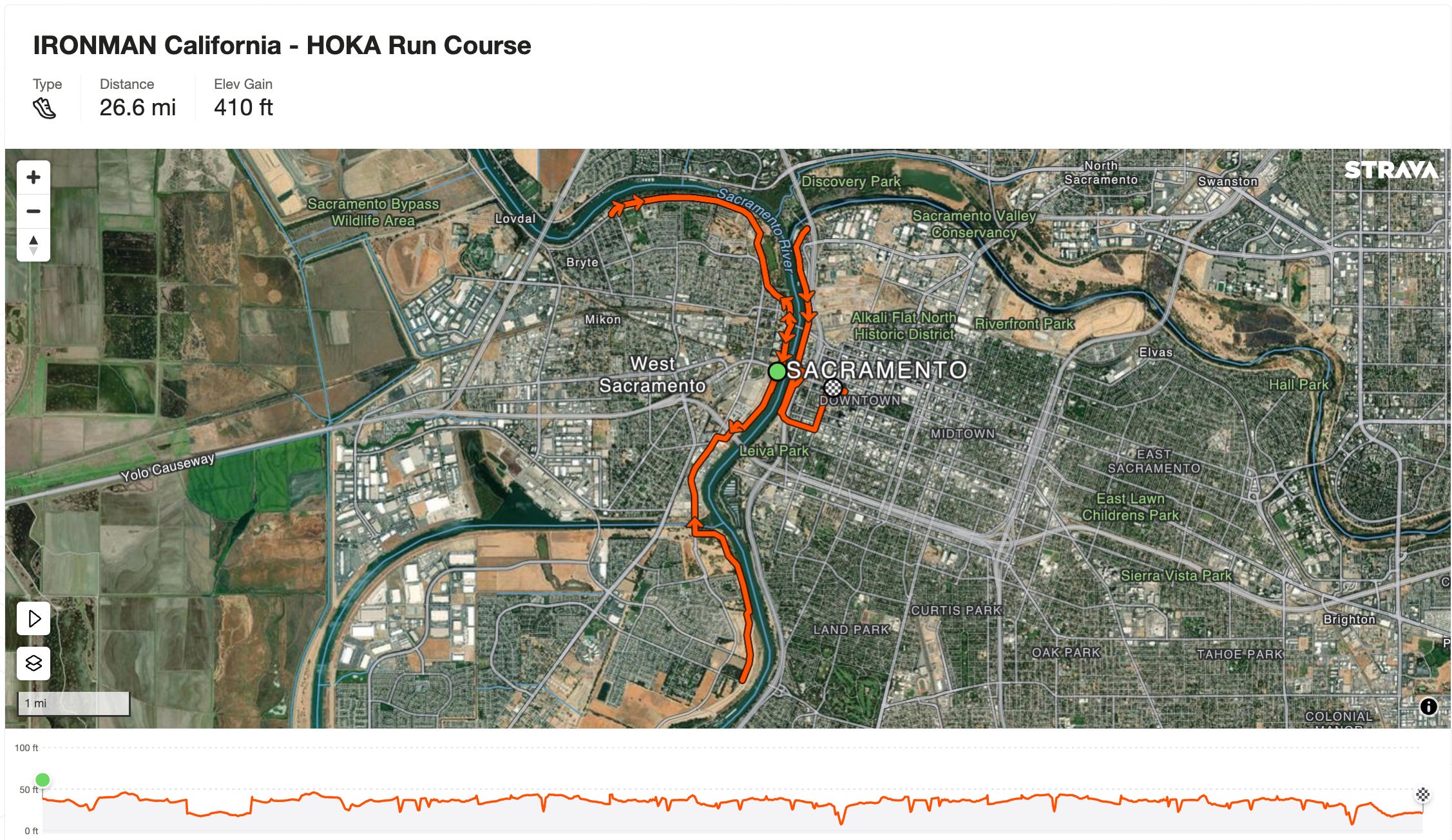
IRONMAN describes the run course as “a flat, fast two-loop run course. This course not only offers the opportunity for the Athlete to PR, but it also offers excellent opportunities for spectators to watch their athletes throughout the course and take in all of the sites, foods, and entertainment Sacramento has to offer.”
As mentioned the course is flat. A great opportunity to run fast—only if you’ve controlled yourself on the bike.
The goal for the day will to be go out at a controlled pace and hold it all day long. No negative (or positive) splitting, just clicking off miles around 6:20-6:25 min/mile (~4:00/km) pace.
My recent runs from Rockford (1:18) and Muncie (1:23), don’t seem on paper to project I’m able to run a sub 2:50 marathon off the bike, but again that’s where I want to prove people wrong.
One of the biggest focuses of my training blocks will be building my run durability—being able to hold a fast pace for long duration off hard bikes.
That’s the real challenge. Not just being fit enough to run fast. Being durable enough to still run fast after the fastest swim and bike I’ve ever attempted.
That’s the block. That’s the bet.
The paying subscribers will be able to see the full 12-week training block breakdown below, the rest of you can stick around for the ride and get the weekly updates of what I’ve been up to each week.
Don’t forget to follow me on Instagram (@eric.r.engel) or give me a follow on Strava.
Thanks,
Eric
Paying subscribers - keep scrolling to check out the 12-week training block ahead.
